
How Does a Damper Work? A Guide to Industrial Airflow Control
October 9, 2026Industrial dampers regulate, redirect, or stop the movement of air and process gases through ductwork. By opening, closing, or moving to an intermediate position, a damper can control flow, isolate equipment, divert a process stream, or prevent reverse airflow.
Understanding how a damper works begins with this basic movement, but choosing the right design requires additional consideration. Temperature, pressure, gas composition, particulate, leakage requirements, duct geometry, and actuation all affect performance. Kelair Dampers custom engineers industrial dampers for application-specific conditions and can help identify the appropriate configuration.
What Is an HVAC Damper?
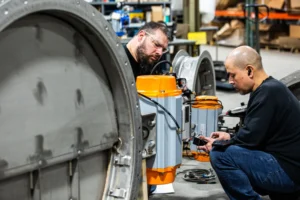
An HVAC damper is a mechanical device installed in ductwork to regulate or stop air or gas flow. In commercial buildings, HVAC dampers may balance air among zones. In industrial HVAC systems, they can also manage process ventilation, combustion air, exhaust, fan flow, corrosive gas, particulate, and elevated temperatures. Industrial dampers may be round, square, or rectangular and use a blade, disc, set of vanes, or sliding plate.
How HVAC Dampers Work
When a damper opens, it creates a larger flow path. Moving toward closed reduces the available area and increases resistance. A closed damper provides isolation or shutoff; an intermediate position can provide modulation or balancing.
Blade position and airflow do not always have a linear relationship. Duct pressure, system resistance, blade design, and nearby fittings affect performance, so selection should consider the entire system rather than duct size alone.
Seals can reduce leakage, with the appropriate type determined by temperature, pressure, media, particulate, and shutoff expectations. Leakage claims should always reflect the specified design and test criteria.
Manual Dampers, Automatic Dampers, and Actuators
Manual dampers are positioned with a lever, handwheel, or chainwheel. They suit balancing, maintenance isolation, or applications that do not require frequent adjustment. Operator access is therefore an important consideration.
Automatic dampers use actuators to respond to control commands. Electric actuators support open/closed operation, modulation, position indication, and control-system integration. Pneumatic actuators use compressed air and may suit fast cycling, spring-return operation, or applications needing high power in a compact package.
Selection should account for torque, cycle frequency, speed, available utilities, environmental classification, fail position, control signal, and position feedback. Kelair offers manual, electric, and pneumatic options and integrated damper-actuator packages.
Common Types of Industrial Dampers
Different damper designs suit different operating goals:
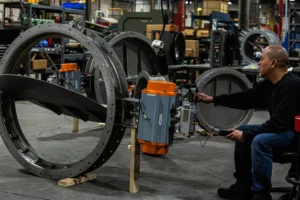
- Butterfly dampers use a rotating disc and provide a compact option for modulation or isolation.
- Louver dampers use multiple blades. Parallel blades suit isolation or quick actuation, while opposed blades can provide smoother modulation.
- Guillotine or slide gate dampers move a blade into or out of the duct for isolation rather than continuous modulation.
- Diverter and tee dampers redirect air or gas from one process path to another.
- Inlet vane dampers regulate air entering a fan or blower.
- Backdraft dampers allow one-way flow and help prevent reversal.
- Stack cap dampers close stack openings during shutdown to limit heat loss and keep foreign material out.
The correct choice depends on whether the required operating mode is modulation, diversion, isolation, fan control, or backflow prevention.
Where Are HVAC Dampers Installed?
HVAC dampers are installed at fan inlets or outlets, duct branches, process bypasses, equipment connections, stack openings, and isolation points. Location affects airflow, pressure drop, accessibility, and control performance. Early planning preserves room for actuators, linkage, inspection, and maintenance.
Specifications should identify temperature, pressure, flow, process media, particulate, allowable leakage, duct dimensions, flanges, and actuation. Harsh environments may require specialty materials, metal seals, refractory lining, or protected linkages.
Qualified personnel should install equipment according to approved drawings. Before startup, confirm orientation, flow direction, alignment, blade clearance, actuator travel, control response, and fail position. Kelair actuator packages can be prewired, pre-piped, calibrated, and tested before shipment.
Dampers, System Efficiency, and Equipment Protection
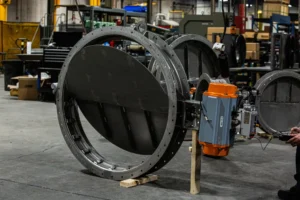
A properly selected damper can direct airflow, reduce unnecessary bypass, support stable conditions, and isolate equipment. Modulating dampers help controls respond to changing demand. These functions may reduce wasted energy and unnecessary operation, although actual savings depend on the complete system.
Dampers can also protect equipment by preventing reverse flow or controlling exposure to heat and particulate. Results depend on correct sizing, materials, seals, actuation, installation, and maintenance.
What About Fire and Smoke Dampers?
Fire and smoke dampers are specialized life-safety devices. Fire dampers limit fire spread through rated assemblies; smoke dampers restrict smoke movement. Applicable codes, listings, approved plans, and manufacturer instructions govern their selection, installation, testing, and access.
They differ from general industrial control or isolation dampers. For fire- or smoke-control projects, identify the required listing, rating, activation method, access, and inspection requirements before selecting equipment.
Damper Maintenance and Common Failure Causes
Maintenance varies with design and environment. Inspect blades, shafts, bearings, seals, linkages, fasteners, actuator operation, position indication, and debris buildup. Heat, corrosion, particulate, excessive cycling, misalignment, and inadequate actuator torque can accelerate wear or prevent full travel.
Cleaning, specified lubrication, actuator adjustment, and visual inspection help reveal problems. Base maintenance intervals on equipment documentation and process severity.
Frequently Asked Questions About Dampers
What Position Should My Damper Be In?
Use fully open for maximum flow, closed for isolation, or an intermediate position for modulation or balancing. Follow the approved control sequence and operating procedure.
Do All HVAC Units Have Dampers?
No. Some HVAC systems include balancing, zone, outdoor-air, backdraft, fire, or smoke dampers, while others do not require every type.
What Is the Average Lifespan of an HVAC Damper?
There is no universal lifespan. Temperature, pressure, media, cycling, materials, actuator sizing, installation, and maintenance all matter. Inspection history is more useful than a generic age limit.
What Causes a Damper to Go Bad?
Common causes include corrosion, particulate buildup, worn seals or bearings, damaged blades, linkage misalignment, actuator problems, and operation outside specified conditions.
Ask Kelair Dampers About Your Application
So, how does a damper work? It moves a blade, vane, disc, or gate to regulate, redirect, or isolate airflow or process gas. Effective performance requires matching that movement to system conditions and controls.
Kelair designs custom industrial dampers for HVAC systems, power generation, pollution control, combustion, refining, and manufacturing. Contact Kelair or request a quote to discuss your airflow, temperature, pressure, shutoff, and actuation requirements.
