

Custom-Engineered Butterfly Dampers for Industrial Airflow Control
Our most economical and best-selling dampers
Download our BrochureKelair Dampers Brochure

Custom-Engineered Butterfly Dampers for Industrial Airflow Control
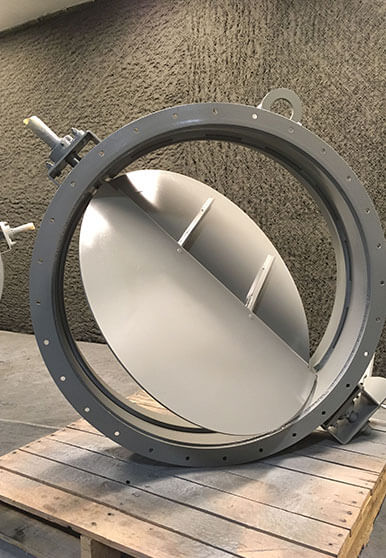
Kelair designs each butterfly damper to deliver reliable airflow control, isolation, and long-term performance in demanding industrial environments. A butterfly damper uses a single rotating disc mounted on a central shaft within the duct. When the blade is parallel to the airflow, it allows maximum flow. When rotated closed, it seals against the duct wall to restrict or isolate the air stream.
Kelair’s butterfly dampers are custom engineered for each application, with sizes ranging from 6 inches to 144 inches and temperature capabilities up to 2,200°F. These units are widely used across power generation, pollution control, petrochemical processing, and heavy industrial systems where durability and consistent operation are essential.
As Kelair’s most economical damper solution, this design provides cost-effective isolation and modulation without sacrificing performance. Whether used as a standalone damper or alongside related components such as a butterfly valve, each unit is built to order with application-specific materials, seals, and actuation systems. Variations such as a butterfly backdraft damper can also be engineered for one-directional airflow control in specialized systems.

Butterfly Damper Specifications: Sizes, Materials, and Performance Ratings
- Sizes: 6″ to 144″
- Process Temperature: up to 2200° F
- Configurations: round, square, & rectangular
- Construction: S.S. or painted C.S. (others available upon request)
- Shutoff: up to 99%
- Seal Options: tad pole, metal seat, swing-thru; control & balancing
- Actuation: manual, electric, pneumatic (spring return and failsafe available)
- Modulation: open/closed or modulating
- Pressure: up to 1-PSI & 4000 FPM process air (higher available upon request)
- Ball bearings and shaft packing glands standard up to 400°F
Actuation Systems: Manual, Pneumatic, and Electric Drive Options
Kelair offers multiple actuation options to ensure each butterfly damper integrates seamlessly into plant control systems and operational requirements.
- Manual actuators (handwheel or lever) provide simple, dependable positioning for basic control applications
- Pneumatic actuators are ideal for fast-response isolation, delivering reliable open/close cycling with optional fail-safe configurations
- Electric actuators enable precise positioning and modulating control, integrating with DCS, PLC, or building automation systems
Actuator selection impacts response time, positioning accuracy, and system integration. Kelair engineers evaluate each application to ensure proper torque, speed, and control compatibility.
Lead times are designed to support project schedules:
- 2–3 weeks for dampers without actuators
- 4–6 weeks standard for fully actuated assemblies
- 3–4 weeks expedited when required

Industries and Applications That Rely on Kelair Butterfly Dampers
Kelair butterfly dampers are used across a wide range of industries where airflow and gas control are critical to system performance.
- Power Generation: Used for boiler isolation, flue gas bypass, and combustion air control in high-temperature environments
- Pollution Control Systems: Applied in scrubbers, baghouses, and precipitators to isolate duct sections and manage gas flow during maintenance
- Petrochemical & Refining: Handle corrosive gases and elevated temperatures in process ventilation systems
- Cement, Mining, and Bulk Processing: Designed to withstand abrasive particulate and heavy-duty operating conditions
In many of these systems, butterfly dampers work in conjunction with other components such as a backdraft damper or specialized duct fittings to provide complete airflow control and system protection.
Kelair’s engineering experience allows for design considerations such as thermal expansion, particulate buildup, and corrosion resistance to be addressed from the outset, ensuring long-term reliability in harsh environments.

Request a Custom Butterfly Damper Quote from Kelair
To receive an accurate quote, Kelair’s engineering team requires detailed application information, including:
- Damper type or configuration
- Duct diameter
- Operating temperature range
- Pressure requirements
- Required shutoff percentage
- Preferred actuation method
Kelair works directly with engineers and facility operators to review each project and recommend the most effective solution. This direct collaboration reduces delays and ensures specifications are aligned from the start.

Commonly Asked Questions About Butterfly Dampers
- What are the benefits of a butterfly damper?
- How are shafts used on these wafer dampers?
- What types of seals are used on a butterfly damper?
- Do butterfly dampers require any maintenance?
- What does proper care look like for the butterfly damper blades?
- What is the minimum information I need to get a quote on a damper?
