
Types of Dampers for Industrial Applications
October 9, 2026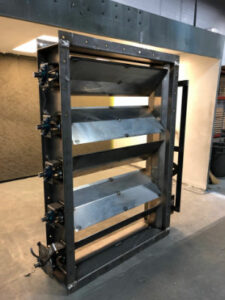
The many types of dampers used in industrial systems share one purpose: controlling air or process gas. Depending on its design, a damper can modulate flow, divert a stream, isolate equipment, prevent backflow, or close an exhaust stack.
The right choice depends on temperature, pressure, process media, particulate, leakage, cycling, space, and actuation, not duct size alone. Kelair Dampers custom engineers each unit around these conditions. This guide explains the primary industrial damper types and where each design fits.
A Quick Overview of Damper Classifications
Industrial dampers can be classified in several ways:
- Blade arrangement: single blade, parallel blades, opposed blades, or a sliding gate
- Operating function: modulation, diversion, isolation, pressure relief, or backflow prevention
- Actuation: manual, electric, or pneumatic
- Application: ventilation, fan control, combustion, pollution control, process bypass, or equipment isolation
- Operating environment: clean air, corrosive gas, abrasive particulate, or high temperature
These categories overlap. A louver may use parallel blades for isolation or opposed blades for modulation, while a butterfly damper may use different materials, seals, and actuators for a specific process.
Blade Arrangements: Parallel Blade Dampers, Opposed Blades, and Butterfly Dampers
Parallel blade dampers rotate multiple blades in the same direction. They often suit open/closed operation, quick actuation, or applications where their discharge pattern fits the ductwork.
Opposed blades rotate in opposite directions, producing a more even airflow pattern for modulation and balancing. The choice must also reflect shutoff, pressure drop, controls, and nearby equipment.
Single-blade butterfly dampers use a rotating disc on a shaft. Their compact construction provides an economical option for control and low-leakage isolation.
Common Types of Industrial Dampers
Butterfly Dampers
Butterfly dampers rotate one blade between open, closed, and intermediate positions. When open, the blade aligns with the flow; when closed, it approaches a seat or seal for the specified shutoff. Kelair configures them for clean air, gas, light particulate, corrosion, or elevated temperatures. Their compact footprint suits power generation, pollution control, refining, and industrial ventilation.
Louver Dampers
Louver dampers use multiple linked blades for modulation, balancing, or isolation in large ducts. Parallel and opposed configurations provide different airflow patterns and control responses. Kelair offers application-specific materials, seals, blade arrangements, and manual, electric, or pneumatic actuation for fan systems, power generation, metal processing, HVAC systems, and pollution control.
Slide Gate and Guillotine Dampers
Slide gate and guillotine dampers move a blade into or out of the process stream. A retracted blade leaves an unobstructed flow path; an inserted blade isolates downstream equipment. These dampers serve open/closed duty rather than continuous modulation. Specify the required leakage rate so we can evaluate the appropriate sealing arrangement.
Diverter and Tee Dampers
Diverter and tee dampers route air or gas between outlets. In a dual-path arrangement, one opens while the other closes; other configurations can modulate, divert, and isolate. Applications include incinerators, thermal oxidizers, cogeneration, heat recovery, and bypass ducts. High temperatures may require suitable alloys or refractory lining.
Inlet Vane Dampers
Inlet vane dampers mount at fan or blower inlets and pre-spin incoming air in the direction of rotation. This regulates volume, reduces fan pressure, and can improve efficiency when properly applied. Kelair designs them primarily for clean air or gas, with manual, electric, or pneumatic operation.
Backdraft and Pressure-Relief Dampers
Backdraft dampers permit flow in one direction and close when it stops or reverses. Depending on the design, they use gravity, counterweights, springs, or actuation. Applications include intake, exhaust, process ventilation, and fan systems.
Pressure-relief dampers open at a designed differential pressure to release excess pressure. Review the opening point, airflow, temperature, and environment with the manufacturer.
Refractory-Lined and High-Temperature Dampers
Refractory lining shields structural components from direct heat and can reduce heat loss or erosion. We can engineer refractory dampers for temperatures up to 2100°F, depending on the configuration. Butterfly, louver, diverter, and other designs may be lined. Provide temperatures, gas composition, pressure, flow, particulate, orientation, and shutoff requirements.
What About Fire and Smoke Dampers?
Fire dampers and smoke dampers are specialized life-safety products. Fire dampers respond to heat, while smoke dampers operate through an approved detection and control system. Combination products perform both functions.
They are not interchangeable with general industrial HVAC dampers. Ratings, listings, installation, access, testing, and inspection depend on adopted codes and approved documents. Confirm those requirements before specifying equipment.
How to Specify the Right Industrial Damper
Before requesting a quote, assemble the following information:
- Required function: modulation, diversion, isolation, fan control, backdraft prevention, or pressure relief
- Duct size, shape, orientation, flange pattern, and available installation space
- Normal and maximum temperature, including excursions
- Flow rate, velocity, pressure, and allowable pressure drop
- Gas composition, moisture, corrosive constituents, and particulate loading
- Required leakage or shutoff performance
- Cycle frequency, operating speed, control signal, and desired fail position
- Preferred materials, seals, actuator, and position-feedback requirements
Frequently Asked Questions About Damper Types
What Types of Dampers Are Used in an HVAC System?
HVAC dampers include volume-control, balancing, zone, backdraft, pressure-relief, outdoor-air, fire, and smoke types. Industrial systems may also use butterfly, louver, guillotine, inlet vane, or diverter designs.
What Are the Three Main Types of HVAC Vents?
The three common categories are supply outlets, return-air grilles, and exhaust outlets. They are terminal devices rather than dampers, although a damper may regulate flow upstream.
How Can I Identify HVAC Dampers?
Look for an external shaft, lever, handwheel, linkage, or actuator on the duct. Drawings, equipment tags, access panels, and control-system records can confirm its function. Do not move an unidentified damper.
Work with Kelair Dampers
Choosing among the different types of dampers begins with function, but performance depends on the entire operating environment. A clean-air design may not suit corrosive gas, abrasive particulate, high heat, frequent cycling, or demanding isolation.
Kelair develops custom industrial dampers for specific process conditions. Contact us or request a quote to discuss your temperature, pressure, media, airflow, shutoff, geometry, and control requirements.
